

15 December 2025
3 min read
Published by:

Businesses in NSW that use, or are considering the use of, digital work systems will need to plan ahead in response to the new Work Health & Safety (WHS) duties relating to technology, currently before NSW Parliament.
Expected to pass in the new year, the Work Health and Safety Amendment (Digital Work Systems) Bill 2025 (NSW) (Bill) reflects a growing regulatory focus on the psychosocial risks associated with algorithmic management and workplace surveillance. If enacted, the Bill will require employers to more closely examine how their digital work systems affect employee health and safety, particularly in relation to workload, monitoring and decision-making.
The Bill introduces specific duties requiring Persons Conducting a Business or Undertaking (PCBUs) to ensure that the use and allocation of work by a 'digital work system' are without risks to health and safety. A ‘digital work system’ is broadly defined as an algorithm, AI, automation or online platform. Common digital tools, which are likely to fall within this definition include automated rostering and performance tracking software.
Importantly, the Bill clarifies that core WHS duties apply to the technology itself. This means that the law treats the algorithm, AI, or the automated scheduler not just as a piece of equipment, but as a system of work that the PCBU must actively design, monitor and control to prevent harm, just like any other hazard in the workplace.
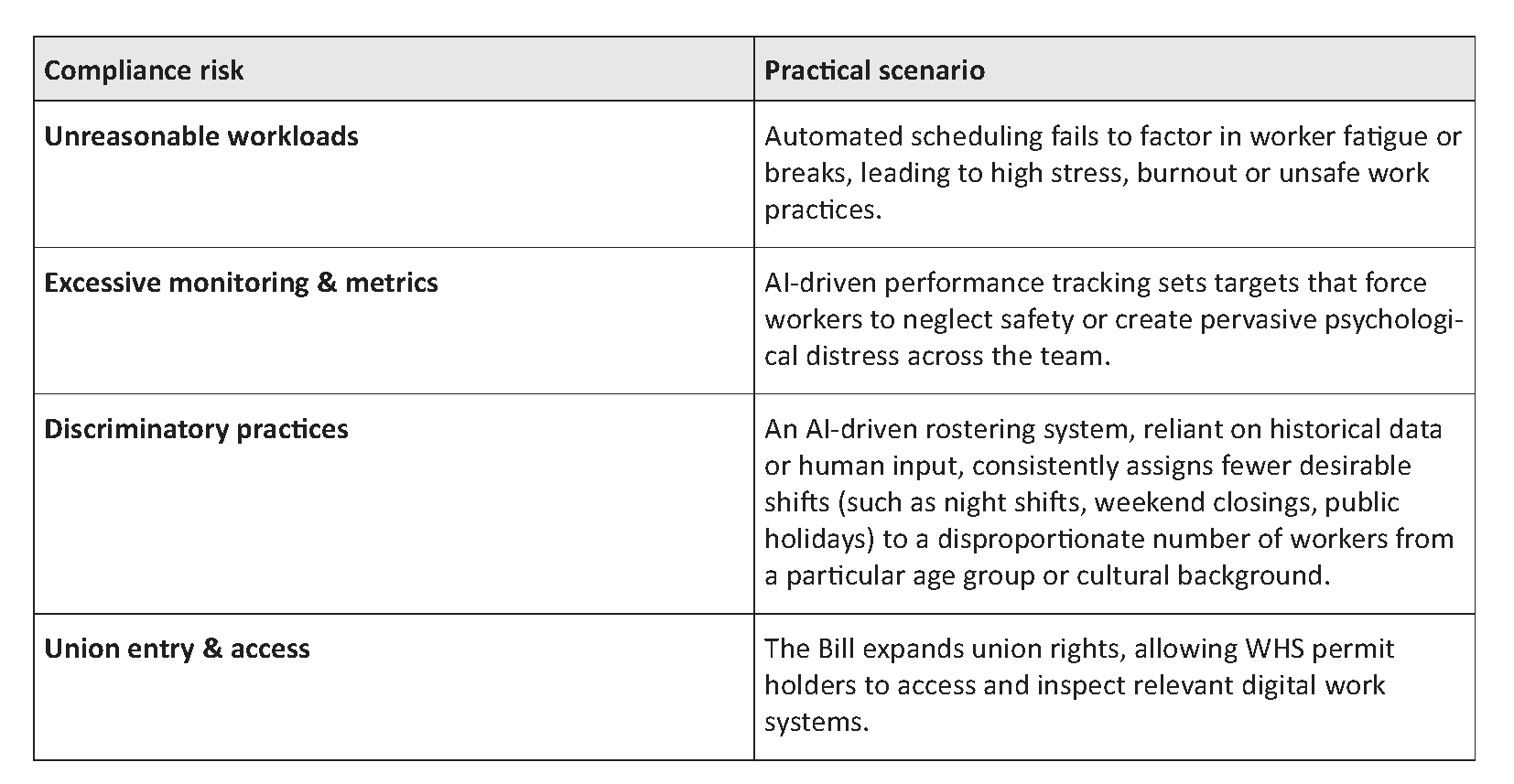
Under the proposed framework, the PCBU must ensure that outputs generated by the relevant digital work system does not result in:
The main challenge for businesses in complying with the proposed WHS obligations lies in interpreting the ambiguous legal terms, such as what constitutes ‘unreasonable workloads’ or ‘excessive monitoring & metrics’. To illustrate how these duties could apply in your workplace, we outline some scenarios below:
Meeting your existing 'reasonably practicable' WHS obligation requires forward planning, including integrating the new duties relating to digital work systems into your business’s existing WHS framework.
To prepare, businesses may consider the following steps:
If you would like to discuss how the new WHS duties may impact your business, or need assistance implementing the essential changes ahead of the new duties becoming law, please contact us here.
Disclaimer
The information in this article is of a general nature and is not intended to address the circumstances of any particular individual or entity. Although we endeavour to provide accurate and timely information, we do not guarantee that the information in this article is accurate at the date it is received or that it will continue to be accurate in the future.
Published by: