

05 October 2026
11 min read
#Mergers and Acquisitions, #Corporate & Commercial Law, #Competition & Consumer Law
Published by:

For Singapore and Southeast Asian investors, entering the Australian market through a merger or acquisition can offer immediate scale, established customers and local capability. But unfamiliar regulatory requirements can affect timing, cost and deal certainty.
In part 1 of this series, we outlined common M&A issues for Southeast Asian investors, including deal structuring and term sheets, and analysed current market trends. This second instalment examines how due diligence, foreign investment clearance, Australia’s mandatory merger control regime and key commercial terms in Australian M&A agreements could affect timing, conditionality and transaction risk.
What to include in a due diligence review
As in Singapore and other Southeast Asian markets, due diligence is a critical phase of any acquisition. For an Australian target, the review should be designed to identify issues that may affect valuation, regulatory approvals, transaction conditionality and post-completion integration.
A well-structured information request will usually cover the following areas:
Employment diligence is particularly important because Australia has a highly regulated and comparatively complex workplace framework. Investors should review employment contracts, modern award coverage, enterprise agreements, contractor arrangements, superannuation compliance, accrued entitlements and potential underpayment exposure. Worker classification should receive particular attention, as misclassification may create liabilities under employment, superannuation, workers’ compensation and payroll tax regimes.
Industry-specific diligence should also be considered at the outset. For example, motor vehicle dealerships are subject to state-based licensing requirements, while regulated sectors such as transport, logistics, healthcare, education, defence, telecommunications and financial services may raise additional approval, licensing or operational issues.
How long does due diligence take in Australia?
Timing depends on the transaction structure, the target’s size and complexity, and how well the data room has been prepared. For Southeast Asian acquirers planning resource allocation and board reporting, the following timeframes provide a general guide:
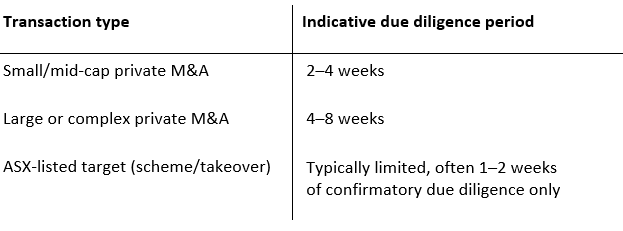
In Australian practice, due diligence typically commences once a non-disclosure agreement or non-binding indicative offer has been executed. Vendors and targets will usually establish a virtual data room, and competitive sale processes often impose disciplined review periods.
Where clearance from the Foreign Investment Review Board (FIRB) or the Australian Competition and Consumer Commission (ACCC) may be required, regulatory analysis should begin during due diligence rather than after signing. This allows the parties to address approval risks, timing and cooperation obligations in the transaction documents.
Australia’s FIRB regime compared with Singapore’s SIRA
Singapore investors should be aware that Australia’s foreign investment regime under the Foreign Acquisitions and Takeovers Act 1975 (Cth) (FATA) is materially broader than Singapore’s Significant Investments Review Act 2024 (SIRA).
While SIRA is directed principally at national security and critical infrastructure concerns, FATA regulates a wider range of investments in Australian businesses, entities and land. Transactions are assessed against Australia’s ‘national interest’, which may include national security, competition, tax, economic and community considerations. The Treasurer is the statutory decision-maker and receives advice from FIRB.
When is FIRB clearance required?
Australia’s foreign investment framework is governed by FATA and the Foreign Acquisitions and Takeovers Regulations 2015 (Cth). The FIRB reviews foreign investment proposals and makes recommendations to the Treasurer, who may grant a ‘no objection’ notification, impose conditions or prohibit a transaction.
While there are a range of thresholds to consider, foreign entities must generally obtain clearance before starting an Australian business or acquiring an interest in Australian land.
Starting a business includes activities such as applying for an Australian Business Number (ABN), taking a lease, engaging employees, or entering into business contracts. An interest in Australian land includes freehold interests and leases or licences with a term (including renewals) reasonably likely to exceed five years.
Monetary thresholds and foreign government investors
Entities with foreign government ownership requires particular care. A nil monetary threshold may apply if the acquirer is a foreign government investor (FGI), meaning FIRB clearance may be required regardless of the transaction value.
An entity may be classified as an FGI if a foreign government holds a 20% or greater interest, although the rules are complex and should be considered carefully. Private investors from treaty countries such as Singapore may benefit from higher monetary thresholds for non-sensitive businesses, while lower thresholds apply to sensitive sectors such as transport and logistics. Thresholds are indexed and should be confirmed when planning the transaction.
How long does FIRB clearance take?
Once the application fee is paid, the Treasurer has a statutory 30-day decision period and may extend this period by up to a further 90 days. Straightforward applications may be resolved within 30 to 40 days, while sensitive-sector or FGI applications may take approximately three to six months from lodgement to decision.
If an investor needs to obtain a FIRB ‘no objection’ notification before starting a new business or acquiring a controlling stake (more than 20%) in an Australian company but proceeds without it, they could face criminal prosecution, civil penalties or divestiture orders. Directors and officers may also face personal liability.
Common FIRB clearance conditions
Investors should be aware that even if a FIRB ‘no objection’ notification is granted, the approval may come with conditions. Common conditions include notifying FIRB before expanding into new business activities, obtaining separate clearance on land acquisitions, appointing independent Australian-resident directors, starting the approved business within 12 months from clearance and meeting periodic reporting obligations.
How Australia’s mandatory merger regime works
Australia’s merger control framework became mandatory and suspensory on 1 January 2026, preventing parties from completing a notifiable transaction until the ACCC has granted clearance and the appeal period has expired. For acquirers, competition analysis should therefore begin early as it can significantly affect deal timing and should not be treated as a regulatory step to address only after signing.
When must an Australian acquisition be notified to the ACCC?
All acquisitions of shares or assets must be notified to the ACCC if the target carries on business in Australia and the prescribed control and monetary thresholds are met. For share acquisitions, notification is triggered where the acquirer gains ‘control’ over the target or crosses a prescribed voting-power threshold, such as moving above 20% or 50%.
Monetary thresholds vary depending on the size of the acquirer and target, but broadly apply where the parties’ combined Australian revenue is at least AU$200 million, or AU$500 million for very large groups, and the target’s Australian revenue or the transaction value exceeds specified minimums. The thresholds may also capture serial acquisitions by aggregating revenue from targets acquired in the same industry over the preceding three years.
Certain transactions are exempt, including acquisitions in the ordinary course of business, internal restructures, and specified financial market and superannuation transactions.
The ACCC assesses whether the transaction would substantially lessen competition, including by creating, strengthening, or entrenching market power. If the transaction fails to satisfy this competition test, parties may apply for clearance on net public benefit grounds.
Merger review timelines and fees
The review process has two phases. Phase 1 is expected to take about 30 business days, while Phase 2 may take approximately 90 to 120 business days for transactions requiring closer scrutiny. Parties may also seek a notification waiver for straightforward transactions that clearly do not raise competition concerns.
Fees range from AU$8,300 for a waiver application to AU$56,800 for Phase 1 and up to AU$1.6 million for Phase 2, reflecting the depth of the ACCC’s analysis. A party may apply to the Australian Competition Tribunal for a limited review of the ACCC’s decision within 14 calendar days.
What the merger regime means for deal timing
The mandatory standstill obligation means that deal timetables must accommodate the full review period, which may be three to six months or longer for complex transactions. ACCC clearance is typically included as a condition precedent in a share sale agreement or business sale agreement, with the long-stop date set by reference to the expected review timetable, the statutory appeal period and an appropriate buffer.
Once the regulatory pathway is clear, attention turns to the commercial terms that allocate execution risk between the parties. Many of the concepts will be familiar to Singaporean dealmakers and investors, but Australian market practice has distinct features, particularly in relation to conditionality, security releases, earn-outs, transition support and restraints.
Regulatory approvals and other conditions before completion
If ACCC approval, FIRB clearance or another regulatory consent is required, the agreement should make that approval a condition that must be satisfied before completion. It should clearly state who is responsible for filing, providing information, engaging with regulators and accepting any conditions, as well as what happens if approval is delayed, refused or granted on onerous terms.
Third-party consents are also commonly included as conditions precedent. These may include financier consent under debt facilities, supplier or customer consent under change-of-control clauses, landlord consent under commercial leases and approvals under joint venture or franchise arrangements. Identifying these consents during due diligence is important because delays can affect both signing strategy and completion certainty.
The transaction documents should also address the discharge of security interests registered on the Personal Property Securities Register (PPSR). The PPSR is Australia’s national register under the Personal Property Securities Act 2009 (Cth) and records security interests in personal property, including equipment, vehicles, inventory, receivables and other non-land assets. Compared with Singapore’s company charges regime, the PPSR is broader and more central to Australian secured transactions practice. Buyers will usually require releases, discharges or appropriate undertakings before, or at, completion.
Using earn-outs to bridge valuation gaps
Earn-outs are common in Australian M&A when the parties cannot agree on valuation or the target's future performance is uncertain (for example, start-ups or businesses with significant pipeline revenues). As in their home jurisdictions, Southeast Asian acquirers should be aware that earn-outs create ongoing obligations after completion and require careful structuring.
It is not unusual for an earn-out to represent 10% to 20% of the purchase price, though the appropriate amount depends on the target’s risk profile, forecast reliability and the buyer’s appetite for post-completion exposure. Earn-outs can bridge valuation gaps, but they should be supported by detailed provisions dealing with performance metrics, accounting principles, control of the business during the earn-out period, information rights, dispute resolution and anti-avoidance protections.
Transition services after an acquisition
A transition services agreement (TSA) is also typical where the seller or target agrees to support the target business operationally for a defined period after completion. TSAs are particularly common in Australian carve-out transactions, where the target has relied on group services such as IT, human resources, payroll, accounting, procurement or facilities management. Buyers should focus on the scope and price of the services, service standards, liability, termination rights and a clear exit plan so that the target can operate independently once the transition period ends.
Restraints of trade in Australian M&A deals
A Southeast Asian investor may seek restraint of trade protections to preserve goodwill by preventing key sellers or management from establishing, joining or assisting a competing business for a defined period after completion.
Australian courts generally require restraints to be reasonable in their duration, geographic reach, restricted activities and the legitimate interest they protect. Unlike in some jurisdictions, where an overly broad restraint may be struck out entirely, Australian transaction documents often use cascading or ‘waterfall’ restraints. This approach may allow a court to sever or narrow parts of the restraint so that the remainder can be enforced, where permitted.
In practice, Australian M&A execution is most effective when due diligence, regulatory strategy and transaction drafting are considered together. Due diligence findings often determine whether FIRB or ACCC clearance is required, whether third-party consents are important, whether warranties or indemnities should be expanded, and whether completion mechanics need additional protections. While many practical aspects of M&A transactions are consistent with Southeast Asian deals, Australia has distinct regulatory requirements that investors should address early.
Investors looking to enter the Australian market can refer to our annual M&A Review for more information on Australia’s foreign investment and merger regimes, recent deal trends and key developments likely to influence dealmaking in 2027, particularly in the renewable energy, technology, funds management, real estate and healthcare sectors.
Our next article in this series will turn to completionmechanics, purchase price adjustments and post-completion obligations. If you are considering a transaction in Australia or have questions about the M&A process, please get in touch with us.
Disclaimer
The information in this article is of a general nature and is not intended to address the circumstances of any particular individual or entity. Although we endeavour to provide accurate and timely information, we do not guarantee that the information in this article is accurate at the date it is received or that it will continue to be accurate in the future.
Published by: