

04 June 2026
7 min read
Published by:

In an ideal leasing arrangement, the landlord-tenant relationship is straightforward: rent is paid on time, the store trades within its agreed hours, and disputes over outgoings and obligations are rare. In reality, issues can arise quickly. A tenant’s business may not be trading well, payments start to 'need a few more days', communication becomes sporadic, and operational concerns begin to signal deeper financial or legal problems.
These situations require prompt and strategic decision-making by landlords. While retail leasing laws differ across Australia, the key pressure points for landlords remain the same. This article provides a practical roadmap for navigating common challenges, including default, termination, relief against forfeiture applications, and how landlords might respond when tenants raise counterclaims during enforcement action.
Termination rights generally arise from non‑payment of rent, breaches of essential terms, repeated defaults, abandonment, or certain insolvency events. In most cases, the issue is not whether a landlord has a right to terminate, but whether that right is exercised correctly.
For landlords, termination is often effected by enforcing the right of forfeiture, that is, bringing the lease to an end and recovering possession of the premises. This process is technical, and even a landlord with a legitimate grievance can still lose its position through a defective notice, premature re-entry, or by conduct that amounts to waiver of the tenant’s breach.
Most leases and relevant property legislation require the landlord to issue a breach notice before termination, particularly for breaches other than non-payment of rent. The notice must clearly identify the breach, specify the steps the tenant must take to remedy it, and allow the required statutory or contractual timeframe. A vague or defective notice can unravel the entire termination process and give the tenant grounds for dispute.
The table below sets out the minimum statutory period a landlord must provide in each state to allow a tenant to remedy a breach before termination can occur.
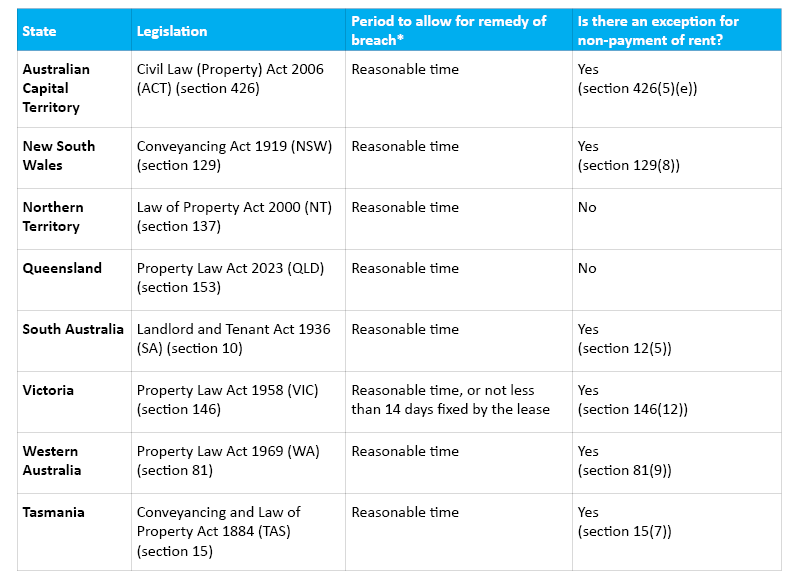
*Note: the relevant legislation prescribes the minimum notice period only. Where the lease specifies a longer remedy period, landlords must comply with the lease requirement (or any greater period required depending on the nature of the breach).
Landlords should also take care not to inadvertently waive their termination rights. Continuing to demand or accept rent after issuing a breach notice can affirm the lease and prevent termination.
It is also important to remember that ending a lease does not automatically result in the tenant vacating or surrendering possession of the premises. Depending on the lease terms and the state legislation, a landlord may have a right of re-entry or may need to seek possession through court or tribunal proceedings. Re-entering too early, changing locks prematurely, or taking informal possession steps without strict compliance can expose landlords to claims for wrongful termination, damages, and applications for relief against forfeiture.
Key actions for landlords
Termination is not always the end of the story. In each state, a terminated tenant can apply to a court or tribunal for relief against forfeiture. The focus is often less on whether the landlord was technically entitled to terminate, and more on whether it would be fair and just to give the tenant another opportunity to continue the lease.
Courts and tribunals are often prepared to grant relief where the breach is capable of being remedied, particularly in cases involving rent arrears, if the tenant can promptly pay outstanding amounts, reimburse the landlord’s costs, and provide assurance that future compliance will occur. This is especially common where the tenant has invested significantly in the premises, operates an established business, or termination would cause disproportionate hardship.
In response to such proceedings, landlords should be prepared to demonstrate the seriousness of the breach, the tenant’s compliance history (e.g. repeated defaults, broken payment arrangements and ongoing trading failures), and any prejudice reinstatement would cause (e.g. reputational issues, disruption to leasing strategy and tenant mix). Courts and tribunals are generally less sympathetic to tenants where the breach reflects a pattern of ongoing non-compliance.
Relief applicants must generally be made within six months from the date the landlord recovers possession, so it is important not to re‑let the premises too quickly. If an application is filed or reasonably anticipated, the court or tribunal may restrain the landlord from granting a new lease to a third party until the matter is resolved. Premature re-letting can expose landlords to claims from both former and incoming tenants.
In some cases, consenting to reinstatement on strict conditions, such as immediate payment of arrears, bank guarantees, or revised lease obligations may be commercially preferable to lengthy litigation.
Key actions for landlords
A tenant facing termination or enforcement action will often respond with a counterclaim. These can take many forms, but common examples include allegations of failure to repair or maintain common areas, misrepresentation during lease negotiations, incorrect outgoings charges, disruption caused by redevelopment or centre works, inadequate or obstructed access and trading interference. In some cases, tenants may also allege that the landlord has engaged in misleading and deceptive conduct or unconscionable conduct giving rise to a damages claim on the tenant’s part, which may be argued in an attempt to overcome a no set-off clause in the lease.
Counterclaims invariably complicate enforcement of the lease. Even where the tenant is clearly in default, a counterclaim will undoubtedly delay proceedings, and potentially reduce or offset outstanding arrears, undermine termination rights and increase legal costs. It is important to distinguish between genuine legal exposure and tactical resistance. Some counterclaims are raised primarily to delay enforcement, create leverage in negotiations, or support an application for relief against forfeiture. Others identify real compliance issues that require immediate attention. Early legal assessment can help determine next steps.
The best defence? Preparation. Landlords who maintain clear maintenance records, well-documented outgoings calculations, accurate disclosure statements, and records of all written communication with tenants will be in a stronger position to address counterclaims quickly and effectively.
Key actions for landlords
When a retail relationship breaks down, landlords often feel pressure to act quickly. However, acting too quickly, or informally, can create far greater problems than the tenant’s breach itself. In these situations, landlords should:
A measured, evidence‑based approach not only protects the landlord’s legal position, but also strengthens commercial leverage and improves the likelihood of an efficient resolution.
If you have any questions about the landlord-tenant relationship, please contact us here.
Disclaimer
The information in this article is of a general nature and is not intended to address the circumstances of any particular individual or entity. Although we endeavour to provide accurate and timely information, we do not guarantee that the information in this article is accurate at the date it is received or that it will continue to be accurate in the future.
Published by: