

16 February 2026
3 min read
Published by:

The Occupational Health and Safety (Psychological Health) Regulations 2025 (Regulations) commenced in Victoria late last year, imposing new and more prescriptive obligations on employers to manage psychosocial hazards. For many organisations, this will require a shift away from policy‑led approaches towards more proactive changes to how work is designed, managed and performed.
Similar to the framework that has long applied to physical hazards, the Regulations require employers to identify, assess, control and review risks to psychological health. The changes align Victoria with other Australian jurisdictions and reflect a broader regulatory and governance expectation that psychological health is a core component of workplace safety.
Given the enforcement powers available to WorkSafe Victoria, and the link between compliance with these obligations and successful workers’ compensation claims, employers that do not adapt their approach confront increased regulatory and litigation risk.
Psychosocial hazards are broadly defined as factors arising from the work environment, work design or management of work that may cause an employee to experience a negative psychological response, creating a risk to their health and safety.
Common examples include:
Traditionally, many employers have approached psychosocial risks through human resources frameworks, relying primarily on policies, codes of conduct and training programs to influence individual behaviour. The Regulations make clear that this approach is no longer sufficient.
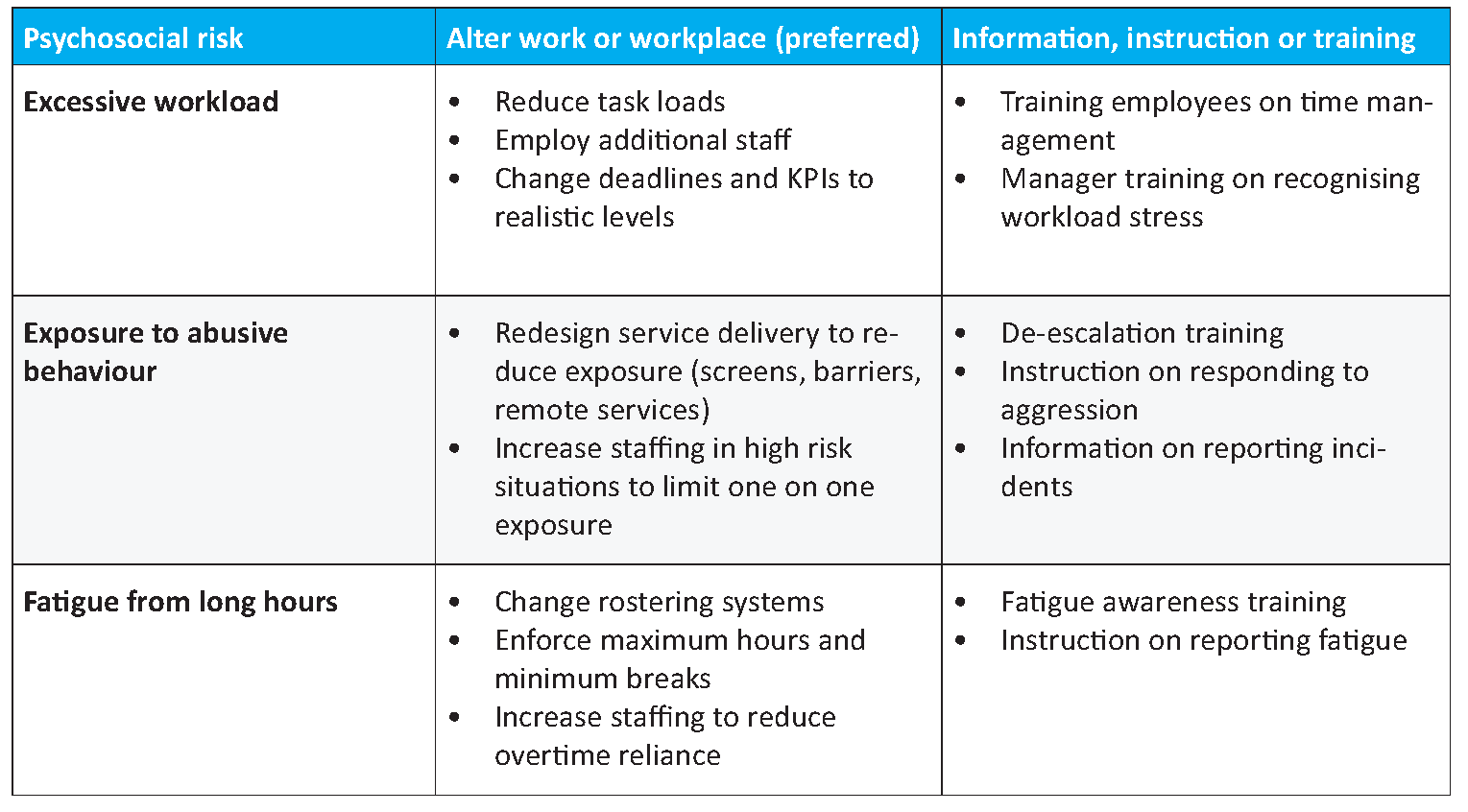
Employers are required to prioritise controls that alter the work or workplace itself, such as work design, systems of work, management practices or the working environment. Information, instruction and training may only be relied upon where these higher‑order controls are not reasonably practicable and must not be the predominant measure where other controls are available.
The distinction is illustrated below:
In light of the new Regulations, WorkSafe Victoria is expected to increase its focus on how employers are identifying and managing psychosocial hazards during audits, inspections and investigations. This may include scrutiny of:
Compliance can no longer be demonstrated by having policies in place or delivering training. Employers must be able to demonstrate active, ongoing management of psychosocial risks.
Employers should take the following steps to ensure compliance:
If you have any questions regarding how to identify and manage psychosocial hazards in your workplace, please contact us here.
Disclaimer
The information in this article is of a general nature and is not intended to address the circumstances of any particular individual or entity. Although we endeavour to provide accurate and timely information, we do not guarantee that the information in this article is accurate at the date it is received or that it will continue to be accurate in the future.
Published by: