

24 July 2026
26 min read
Published by:

[Update] The Bill passed through NSW Parliament on 4 August 2026 and on 14 August was assented. Certain sections relating to manufactured homes will come into force on the date of assent, whilst the balance will come in to force on a date or dates to be proclaimed.
The only amendment was to a schedule which provided consequential amendments to the Residential Apartment Buildings (Compliance and Enforcement Powers) Act 2020, requiring the regulations to establish a scheme by 21 December 2026 for dispute resolution by the Secretary for disputes involving building work.
In this second instalment of our deep dive into the Building (Approvals and Practitioners) Bill 2026, we continue to look at the proposed reforms and their implications for the construction industry, focusing on registration, disciplinary proceedings, investigations and additional powers. See our previous instalment here.
Those looking to relate this to existing legislation can take note that Part 4 of the Bill is in substance, the successor to Part 5 of the Design and Building Practitioners Act 2020 (NSW) (DBPA). The Bill largely preserves the practitioner registration regime from the DBPA, but restructures and broadens it within a single consolidated building approvals framework.
Part 5 of the DBPA contains an occupational registration scheme that covers:
The Bill keeps much of this architecture but reorganises it into a broader ‘whole-of-building’ model.
This is because the DBPA primarily focused on registration of design and building practitioners, regulated designs, design compliance declarations and duty of care obligations. Although the Bill absorbs this, it also includes approvals, all practitioner registrations, regulatory and Council oversight, site interventions and prefabricated buildings.
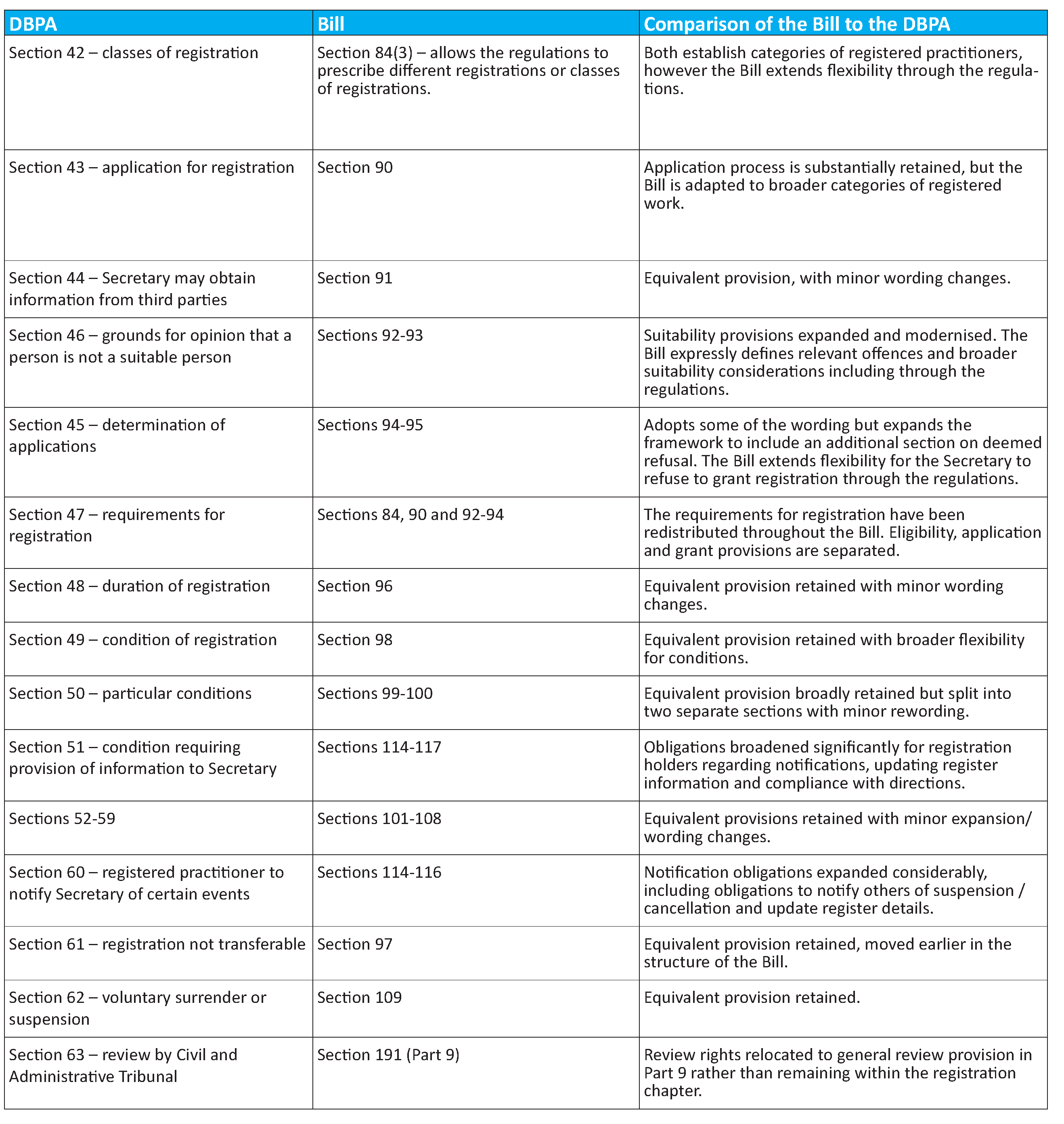
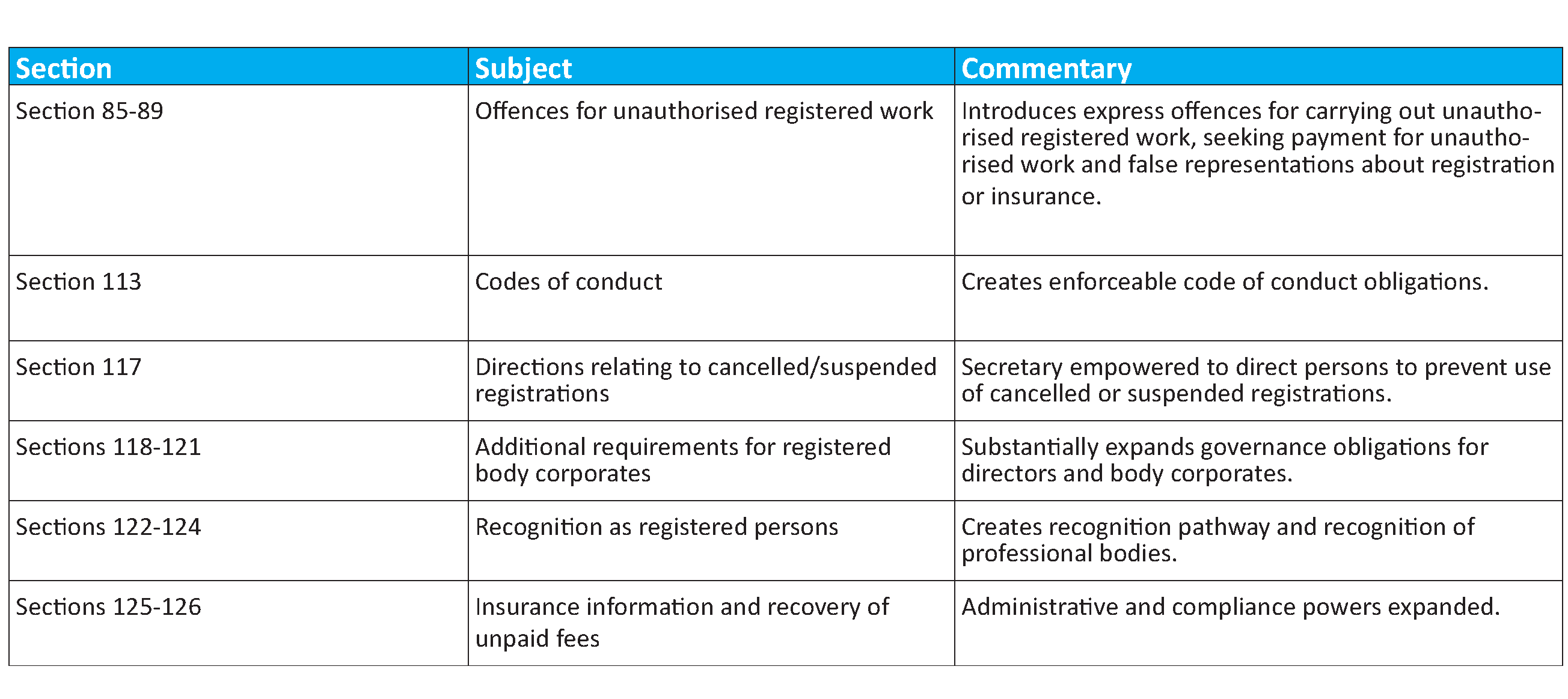
The Bill and section 42 of the DBPA both establish categories of registered practitioners, however the Bill will now extend flexibility in the classes through the regulations (section 84). The Bill substantially retains the application process from the DBPA, but with some adaptations for the fact that there are broader categories of registered work (section 90). Also introduced are offences for carrying out unauthorised registered work, seeking payment for unauthorised work and false representations about registration or insurance (sections 85-89).
The Bill mirrors the DBPA in allowing the Secretary of the Department of Customer Service (Secretary) to require an applicant or a close associate to provide specified information relevant to the investigation of the application and a decision from the Secretary based on failure to provide information is not reviewable (section 91).
The grounds for an opinion that a person is not a suitable person to be registered are adopted from the DBPA, however the suitability provisions are expanded and modernised. The Bill also expressly defines relevant offences and will include broader suitability considerations through the regulations (sections 92-93).
The Secretary’s power to determine an application is adopted from the DBPA, however there is now an additional section on ‘deemed refusal’, where the Secretary fails to give the applicant a notice of a decision within the period prescribed by the regulations (sections 94-95).
Variation, suspension and cancellation of registration is maintained, although expanded to the broadened categories of registration (sections 101-109). This includes registration offences, review by the NSW Civil and Administrative Tribunal and voluntary surrender or suspension of registration.
Interestingly, in the style of Joseph Hellier, the Bill renames the DBPA’s ‘practitioners register’ as the ‘registration register’ (section 110). There is also now a protection for the Secretary, in keeping the registration register, from liability for defamation where information published in good faith is made public.
Whereas the DBPR required that registered design practitioners and registered principal design practitioners required professional indemnity insurance and that registered professional engineers and building practitioners must meet insurance requirements, the Bill has simplified and broadened this insurance requirement by requiring that all registration holders must be indemnified with adequate insurance. Adequate insurance is insurance that complies with the regulations (sections 111-112).
Codes of conduct are a new feature of the Bill which extends authority through the regulations to prescribe codes of conduct for registration holders. A code of conduct may specify requirements relating to:
Offences may be created through the regulations for failure to comply with a code of conduct (sections 113, 116).
The Bill has also adopted the DBPA notification requirements for registration holders to the Secretary but significantly broadened the requirements (section 115). Registration holders are now also required to give the registration holder’s employer written notice regarding cancellation, suspensions or changes to their registration (section 114).
The Secretary will also be empowered to take steps to ensure that people are not using cancelled, suspended or varied registrations. Failure to comply with a direction from the Secretary is an offense under the Bill (section 117). Similarly, the Secretary is also empowered to direct a person to give the Secretary information about insurance policies and any unpaid fees may be recovered by the Secretary as a debt (subsection 125-126).
Body corporates receive substantially expanded governance obligations, including for directors. Directors must ensure the body corporate complies with all requirements of the Bill and appropriate management systems are in place (section 118).
Body corporates must ensure that registered work is being carried out only by authorised individuals (section 119). This includes approvals work, where the body corporate must ensure that at least one suitably qualified director is appointed for such work to be completed (section 121). Directors are responsible to report conduct as soon as they suspect, or reasonably suspect, that misconduct has occurred, that would ultimately result in disciplinary action (section 120).
The Bill also introduces a recognition pathway for registered persons and professional bodies. Persons are recognised if they hold specified qualifications, are recognised by a professional body and are recognised under law (section 122).
Professional bodies will be recognised if they operate an appropriate registration scheme involving reasonable fees, professional development and qualifications and meet the regulations requirements (sections 123-124).
For a side-by-side comparison of maintained provisions, please see the table below:
Highlights of the new provisions are included in the table below:
Part 5: Disciplinary proceedings
Part 5 of the Bill is the successor to Part 6 of the DBPA. However, Part 5 introduces a broader, more structured disciplinary framework, integrated into the wider building regulatory regime.
There are 11 objective disciplinary grounds which have been adopted from the DBPA for which the Secretary may take action, including:
The Bill retains the Secretary’s disciplinary power, extending it to disciplinary action against a registered person, including a former registered person, a registered body corporate and certain persons associated with the body corporate (sections 129, 134-135).
Part 5 adopts the ‘show cause’ process outlined in section 65 of the DBPA, which empowers the Secretary to issue a written show cause notice requiring the registered person to explain why action should not be taken (section 131). This process includes a procedural fairness mechanism that the Secretary must consider submissions made, before deciding whether disciplinary action process. However, immediate steps may be taken if considered in the public interest.
Where a show cause notice is served, the Bill retains the power given to the Secretary to suspend a registration during the disciplinary process. This is intended to address immediate safety concerns and/or ongoing non-compliance risks (section 132).
Overall, Part 5 of the Bill continues and broadens the theme of prevention from the DBPA.
Part 6 of the Bill establishes investigative and compliance powers for the Secretary and authorised officers.
The Bill adopts the authorised officer regime, allowing the Secretary to appoint authorised officers for a specified term (sections 141-144). Those authorised officers have the same information gathering powers as under the DBPA (section 145).
Further to these information gathering powers, the Bill introduces a self-incrimination regime which provides that a person is not excused from giving relevant information if that information may incriminate that person or another person or make them liable to a penalty (section 148). However, the information will not be admissible in criminal or civil proceedings against an individual, as opposed to a body corporate, and in either case may be used as a basis for taking disciplinary action.
Authorised officers retain the power to enter premises where building work is in progress or is usually carried on at the premises (section 150). Search warrants are required for entry into residential premises and will only be granted if it is satisfied that there are reasonable grounds for doing so (section 153).
The powers conferred upon authorised officers once they have entered a premises were found in section 84 of the DBPA. In the Bill, these powers are in their own subdivision and are significantly broadened, including to allow for examinations, inspections and tests of documents and seizures (including destroy/disposal powers) (sections 154-158).
Part 7 of the Bill deals with investigations, which section 163 clarifies does not limit other powers the Secretary may have under the Bill or another Act or law.
The Secretary has powers equivalent to section 92 of the DBPA to investigate, at any time, the following (section 164):
This largely adopts the investigatory power given to the Secretary under section 92 of the DBPA.
The Bill provides that a person may make a complaint to the Secretary about a matter that the Secretary is authorised to investigate under section 164. As under the DBPA, the Secretary is not required to investigate the complaint (section 165).
The Bill retains the power in the DBPA for the Secretary to apply to the Land and Environment Court (LEC) for an order to remedy or restrain a contravention of the Act or regulations (section 166). The Secretary may apply to the LEC for an order whether or not proceedings have been instituted for an offence or there is a likelihood of damages, as in section 91 of the DBPA (section 166). The LEC is authorised to make an interim order before the proceedings are complete, if it considers it is appropriate to do so (section 166(4)). The LEC must not require the Secretary or another person to give an undertaking as to damages for an interim order (section 166(5)). This differs slightly from the DBPA, which prevented the LEC from requiring an undertaking as to damages for ‘an order under this section’ (DBPA section 91(4)).
The Bill empowers the Secretary to publish a notice warning persons of particular risks involved in dealing with a specific registered person, or any other person the Secretary reasonably believes may have contravened the legislation (section 167(1)). Although equivalent to section 99 of the DBPA, the Bill gives the Secretary wider discretion to publish the warning notice in any way it sees fit (section 167(3)).
Before publishing the warning notice, the Secretary must investigate and consult with the person concerned by giving them written notice and giving them not less than two business days to provide submissions (section 167(4)).
In line with the single building approvals framework approach, the Bill empowers the Secretary to conduct an audit of approval authorities.
The Bill allows the Secretary to accept an undertaking from a registered person relating to the carrying out of registered work and the person’s business operations and activities (section 170). This substantively adopts section 88 of the DBPA, however, the Bill introduces penalties for contravening an undertaking (individual 300 units, otherwise 1,500 units), as opposed to disciplinary action under the DBPA.
The Bill expands on the DBPA’s treatment of undertakings by allowing a party to vary the undertaking with the written agreement of the other party (where one is the Secretary), provided that the variation does not provide for a different subject matter (section 171). The Bill also provides that an undertaking ceases to have effect if the undertaking is withdrawn or acceptance of an undertaking is withdrawn by the Secretary (section 172(1)). A person seeking to withdraw their undertaking must obtain written approval from the Secretary and if the Secretary seeks to withdraw acceptance of the undertaking, it must notify the person in writing (section 172(2)-(3)).
The Secretary may also make copies of the undertakings and information in relation to undertakings publicly available (equivalent to section 98A(2) of the DBPA) (section 173).
Again, in line with the single building approvals framework approach, the Bill introduces a power for the Secretary to investigate the work and activities of a Council in its capacity as an approval authority (section 174). This is an expansion of the Secretary’s investigatory powers in section 92 of the DBPA, which was confined to investigations of registered practitioners.
The Secretary may undertake an investigation into the Council on its own initiative or following a complaint to the Secretary (section 174(3)). Following the investigation, the Secretary must prepare and provide a copy of its report to the Planning Secretary and the Council (section 174(4)).
The Bill outlines the procedure that must be followed after the Secretary provides its report (section 175):
The final report must be made publicly available (section 175(5)).
In what would surely be extreme circumstances, to justify conditioning the exercise of core Council functions, section 176 of the Bill provides that the regulations may enable the Minister to suspend, or place conditions on, a Council’s authorisation to carry out approvals work.
In the next and final instalment of our three part series, we will be closing out the remaining Parts 8 & 9 of the Bill.
If you would like more information about the Bill or have questions about how the proposed changes could impact your business, please contact us here.
NSW Budget 2026-27 Industry Insights
The 2026/27 State Budget was handed down today by NSW State Treasurer David Mookhey. The Budget includes some welcome measures to accelerate housing approvals, support Modern Methods of Construction and maintain a substantial pipeline of public infrastructure work. In his speech in the NSW Legislative Assembly today, Mookhey noted that private investment is now the leading source of economic growth in NSW. He stated that no other state in Australia can say the same. Read more here.
HIA warns of fresh housing cost rise without fuel excise extension
The Housing Industry Association (HIA) has called for a three-month extension of the fuel excise relief and pause on heavy vehicle road user charges that lapse on 30 June, which risk triggering another round of housing materials cost increases. Read more here.
The NSW Budget builds on existing housing supply reforms
“HIA welcomes the initiatives to support new housing announced by the Treasurer as part of today’s NSW State Budget… Although these measures are modest, they build on existing reforms aimed at increasing housing supply,” said Brad Armitage HIA NSW Executive Director. Read more here.
NSW takes first step toward unwinding housing's worst own goal
“The NSW Government has taken an important step toward improving housing supply. Other states should now follow its lead and remove foreign investor taxes that discourage the construction of new homes,” said HIA Chief Economist Tim Reardon. Read more here.
Negative gearing, CGT and SMSF changes should have been red carded
The Housing Industry Association (HIA) has called the passage of changes to negative gearing, capital gains tax (CGT) and self-managed super fund (SMSF) investment rules a major setback for housing supply, warning the measures should have been ‘red carded’ before being legislated. Read more here.
Why falling house prices won’t be an economic disaster
When consumers feel richer, they’re also more likely to loosen the purse strings, according to conventional economic wisdom. And for most of the last three decades, the biggest source of household wealth – real estate – has been heading in one direction: up. So, what happens to household spending when people’s biggest asset starts losing value, instead of rising? And how much does it really matter for the wider economy? Read more here.
Sydney and Melbourne tipped to lead housing price drops as market cools
Domain forecasts house prices could drop up to 7 per cent in Sydney and up to 8 per cent in Melbourne over the next year, as interest rate hikes and tax policy changes impact the market. A separate report from Cotality showed the median gain from home resales hitting a record in the first quarter of the year, as sellers benefited from years of price rises. Read more here.
Building Commission NSW fees to increase from 1 July 2026
From 1 July 2026, Building Commission NSW fees will increase by approximately 4.4 per cent in line with movements in the Consumer Price Index (CPI). Read more here.
NSW to set up modular housing factory to 'turbocharge' delivery of new homes
The New South Wales government is looking to partner with construction companies to create a new modular housing factory to "turbocharge" the delivery of new homes. It is opening a tender process for a Modern Methods of Construction Innovation Facility, where prefabricated housing modules and components could be built faster and more cheaply. Read more here.
Anti-money laundering and counter-terrorism financing (AML/CTF): Guide for property developers
This plain-English guide is designed to help property developers and integrated developer-operators prepare for becoming reporting entities under amendments to the Anti-Money Laundering and Counter-Terrorism Financing Act 2006 (the Act) that commence from 1 July 2026. Access the guide here.
Housing Innovation in Construction Fund
The NSW Government has committed up to $2 million in Financial Year 2027. The program supports the NSW Government's commitment to driving strategic outcomes across NSW, aligning with the Housing Mission identified in the Industry Policy, supporting the investment pillars of the Trade & Investment Strategy, and leveraging innovation through the Innovation Blueprint to tackle key challenges and drive priority missions. Find out if you are eligible for a grant here.
ABS - Building Approvals, Australia
The Australian Bureau of Statistics (ABS) provides an overview of the number of dwellings and value of buildings approved. The May 2026 seasonally adjusted estimate revealed that total dwellings approved fell 1.1% to 17,019. Private sector dwellings excluding houses fell 10.4% to 6,034 and private sector houses rose 2.8% to 10,537. The value of total residential buildings fell 5.7% to $10.24b. Access the release here.
From factory to front door: plan to deliver homes faster in NSW
The Minns Labor Government is turbocharging the way homes are built in NSW, unlocking the potential of Modern Methods of Construction (MMC) to deliver more high-quality homes, faster. The 2026-27 NSW Budget will invest in a world-class facility to harness cutting-edge prefabrication, modular construction and digital technologies to produce high-quality housing faster, helping cut construction times, ease cost pressures and strengthen NSW’s building supply chain. Read more here.
Around 1,300 new homes coming to Nowra and Kiama
The Minns Labor Government is enabling the delivery of around 1,300 new homes across the NSW South Coast, finalising three major rezonings that will transform underutilised land in Nowra and Kiama into vibrant, well-connected neighbourhoods. Read the release here.
Land Audit grows housing pipeline by 670 homes
The Minns Labor Government is delivering more homes. The land audit has identified more than 670 new homes which could be delivered across surplus and underutilised NSW Government-owned sites as part of the NSW Government’s $6.6 billion Building Homes for NSW program to help deliver 30,000 homes across the state. Read more here.
Kalantzis v Secretary, Department of Customer Service [2026] NSWCATOD 86
ADMINISTRATIVE LAW – application for review of decision to cancel supervisor certificate and impose a disqualification period of five (5) years – whether Applicant guilty of improper conduct – whether Applicant is a defacto director of a company – whether Applicant is fit and proper person to hold the certificate
Administrative Decisions Review Act 1997 (NSW); Home Building Act 1989 (NSW); Public Health (COVID-19 Temporary Movement and Gathering Restrictions) Order 2021; Work Health and Safety Act 2011 (NSW); Work Health and Safety Regulation 2017 (NSW)
Diab v Secretary, Department of Customer Service [2026] NSWSC 693
ADMINISTRATIVE LAW – jurisdictional error – cancellation of contractor licences – whether Secretary is required to refuse
STATUTORY INTERPRETATION – departure from literal meaning – “may” – Home Building Act 1989 (NSW) s 33C(3) – prima facie presumption displaced – provision mandatory
Corporations Act 2001 (Cth), s 9; Home Building Act 1989 (NSW), ss 19, 20, 21, 22, 33B, 33C; Interpretation Act 1987 (NSW), ss 5, 9, 34(1)(b)(ii); Supreme Court Act 1970 (NSW), s 69; Home Building Amendment Act 2014 (NSW)
Goel v The Secretary, NSW Department of Customer Service [2026] NSWCATAP 191
APPEALS – building licence applications – challenge to Tribunal’s finding that appellant was not a “fit and proper person” – no error by Tribunal established – appeal dismissed
Civil and Administrative Tribunal Act 2013 (NSW); Civil and Administrative Tribunal Rules 2014 (NSW); Home Building Act 1989 (NSW)
Majzoub v Secretary, Department of Customer Service [2026] NSWCATOD 89
ADMINISTRATIVE LAW – qualified supervisor certificate in the category of disconnection and reconnection of fixed electrical equipment (appliances and motors) – qualifications required by the Instrument – scope of work within the Instrument
Administrative Decisions Review Act 1997 (NSW); Home Building Act 1989 (NSW)
Bond Mayhew Pty Limited ATF Mayhew Cooper Crawford Superannuation Fund v Kerry Spicer [2025/00140171]; Kerry Spicer v Bond Mayhew Pty Limited ATF Mayhew Cooper Crawford Superannuation fund [2025/00027953] [2026] NSWDC 19
BUILDING AND CONSTRUCTION — contract — damages — delay — defects — claim for consequential pure economic loss — proper construction of cl 17.2 of standard form contract requiring builder to give notice claim for extension of time — Champion Homes considered and applied the facts the parties did not agree to liquidated damages is irrelevant to the proper construction of cl 17.2
CONTRACTS — assessment of damages for breach of contract — Prima facie position — Bellgrove v Eldrige discussed — provisos identified — breach — damages — proof — defects — proper construction of Australian Standards and proper construction of s 18B(1)(c) warranties — Decision of Court of Appeal in Owners SP 92450 v JKN Para 1 Pty Limited considered — approach to damages for breach of statutory warranties no different to approach for any other breach
Building and Construction Industry Security of Payment Act 1999 (NSW) s 13; Home Building Act 1989 (NSW) s 18B(1)(c)
Neale v Westacres Property Consultants Pty Ltd [2026] NSWDC 209BUILDING AND CONSTRUCTION — contract — damages — defects — purported termination of contract — where property owners excluded builder from site — whether alleged defects were just incomplete work — where the plaintiffs’ breach has a clear causal relationship with the alleged breach of the defendant
Civil Procedure Act 2005 (NSW), s 100; Home Building Act 1989 (NSW); Uniform Civil Procedure Rules 2005 (NSW), schedule 7
Makowski v NSW Self Insurance Corporation; Mircevski v NSW Self Insurance Corporation [2026] NSWCATAP 184
BUILDING AND CONSTRUCTION — contract — insurance — Home warranty – Home Building Act 1989 (NSW) — application to and liability of developers — meaning of owner and developer — whether tenants in common developing eight dwellings are developers — whether intention relevant to question of legal ownership — time at which an assessment of whether owners are developers is to be made
Civil and Administrative Tribunal Act 2013 (NSW), s 80, cl 12 of Sch 4; Civil and Administrative Tribunal Rules 2014 (NSW), r 38 and 38A; Home Building Act 1989 (NSW), s 3A, 48, 92, 96 cls 1 and 2 of Sch 1; Home Building Amendment (Warranties and Insurance) Act 2010 (NSW); Home Building Amendment Act 2011 No 52 (NSW); Real Property Act 1900 (NSW), s 42; Strata Schemes Development Act 2015 (NSW), s 24; Strata Schemes (Freehold Development) Act 1973 (NSW) (Rep), s 18
Blue Mountains Civil Contracting Pty Ltd v Zhao [2026] NSWDC 212
CIVIL PROCEDURE — Summary disposal — judgment for plaintiff — no defence
CIVIL PROCEDURE — pleadings — striking out — no reasonable cause of action or defence — defence
Building and Construction Industry Security of Payment Act 1999, s 8, s 13, s 14; Home Building Act 1989, s 7, s 92; Uniform Civil Procedure Rules 2005, r 13.1, r 14.28
Hordpenko v Yatman [2026] NSWCATAP 197
BUILDING AND CONSTRUCTION — Home Building Act 1989 (NSW) — statutory warranty — defences — s 18F(1)(a) — instructions contrary to written advice
CIVIL PROCEDURE — form of orders
Civil and Administrative Tribunal Act 2013 (NSW); Home Building Act 1989 (NSW)
Georgis v Berry [2026] NSWCATAP 185
CONSUMER LAW - Consumer guarantees - Supply of services - Guarantee as to due care and skill - supplier’s claim to be determined under s 79O Fair Trading Act 1987 (NSW) - Remedies - Compensation orders - major failure of consumer guarantee
Civil and Administrative Tribunal Act 2013 (NSW); Civil and Administrative Tribunal Rules 2014 (NSW); Fair Trading Act 1987 (NSW); Home Building Act 1989 (NSW)
Hanna v Kore [2026] NSWCA 106
BUILDING AND CONSTRUCTION – residential building contract – builder issues payment claim under Building and Construction Industry Security of Payment Act 1999 (NSW) for works at lock up stage – builder proceeds to adjudication and registers adjudication certificate as a judgment – where owners commence proceedings following dispute about termination of the contract – where primary judge found that works had not reached lock up stage and builder not contractually entitled to payment for works the subject of the claim – where primary judge found that owners validly terminated the contract and entitled to damages – application of s 32 Building and Construction Industry Security of Payment Act 1999 (NSW)
Building and Construction Industry Security of Payment Act 1999 (NSW) s 32; Design and Building Practitioners Act 2020 (NSW) s 37; Environmental Planning and Assessment Act 1979 (NSW) Div 9.3; Uniform Civil Procedure Rules 2005 (NSW) Sch 7
Thompson v The Owners – Strata Plan No 31007; The Owners – Strata Plan No 31007 v Thompson [2026] NSWCATAP 183
LAND LAW – Strata title – common property – whether owners corporation liable to compensate lot owner for damage to structures erected on common property over which the lot owner has exclusive use where the damage was occasioned in the course of the owners corporation carrying out repairs or maintenance of common property – whether trespass by the owners corporation affects its potential liability
LAND LAW - Strata title – By-laws - interpretation of by-laws - whether indemnity by lot owner in respect of liability resulting from the use of exclusive use areas extends to damage caused by the owners corporation to structures on the exclusive use areas
Civil and Administrative Tribunal Act 2013 (NSW); Civil and Administrative Tribunal Rules 2014 (NSW); Strata Schemes Management Act 2015 (NSW) s 122
Bills introduced by Government
Revenue and Other Legislation Amendment Bill 2026
Energy and Utilities Administration Amendment Bill 2026
Mining and Petroleum Legislation Amendment (Land Access) Bill 2026
Bills introduced by Non-Government
National Parks and Wildlife Amendment (Land Boundaries and Acquisitions) Bill 2026 (No 2)*
Regulations and other Miscellaneous Documents
Building, Design and Strata Legislation Amendment Regulation 2026 (2026-298) LW 26 June 2026
Real Property Legislation Amendment (Fees) Regulation 2026 (2026-304) LW 26 June 2026
Environmental Planning Instruments
Cumberland Local Environmental Plan 2021 (Amendment No 11) (2026-245) LW 5 June 2026
Ku-ring-gai Local Environmental Plan 2015 (Amendment No 43) (2026-246) LW 5 June 2026
Orange Local Environmental Plan 2011 (Amendment No 42) (2026-247) LW 5 June 2026
State Environmental Planning Policy Amendment (Fitzwilliam Street) 2026 (2026-248) LW 5 June 2026
Cobar Local Environmental Plan 2012 (Amendment No 3) (2026-258) LW 12 June 2026
Lithgow Local Environmental Plan 2014 (Map Amendment No 3) (2026-259) LW 12 June 2026
Parramatta Local Environmental Plan 2023 (Amendment No 23) (2026-260) LW 12 June 2026
Waverley Local Environmental Plan 2012 (Amendment No 29) (2026-263) LW 12 June 2026
Wollongong Local Environmental Plan 2009 (Map Amendment No 13) (2026-264) LW 12 June 2026
Central Coast Local Environmental Plan 2022 (Amendment No 11) (2026-280) LW 19 June 2026
Cumberland Local Environmental Plan 2021 (Amendment No 13) (2026-281) LW 19 June 2026
Junee Local Environmental Plan 2012 (Map Amendment No 4) (2026-282) LW 19 June 2026
Mid-Western Regional Local Environmental Plan 2012 (Map Amendment No 20) (2026-283) LW 19 June 2026
Narromine Local Environmental Plan 2011 (Map Amendment No 2) (2026-284) LW 19 June 2026
Campbelltown Local Environmental Plan 2015 (Map Amendment No 17) (2026-307) LW 26 June 2026
Hornsby Local Environmental Plan 2013 (Map Amendment No 7) (2026-308) LW 26 June 2026
North Sydney Local Environmental Plan 2013 (Amendment No 45) (2026-309) LW 26 June 2026
Parramatta Local Environmental Plan 2023 (Map Amendment No 12) (2026-310) LW 26 June 2026
Wollondilly Local Environmental Plan 2011 (Map Amendment No 14) (2026-315) LW 26 June 2026
Wollongong Local Environmental Plan 2009 (Amendment No 62) (2026-316) LW 26 June 2026
Disclaimer
The information in this article is of a general nature and is not intended to address the circumstances of any particular individual or entity. Although we endeavour to provide accurate and timely information, we do not guarantee that the information in this article is accurate at the date it is received or that it will continue to be accurate in the future.
Published by: