

22 September 2026
5 min read
#Competition & Consumer Law, #Mergers and Acquisitions, #Corporate & Commercial Law
Published by:

Australia’s mandatory merger control regime commenced on 1 January 2026. The ACCC’s updated data for the 2025-26 financial year provides valuable insight into how the new framework is operating and what it means for transaction planning.
Early indications suggest the regime is functioning efficiently, with most notification and waiver determinations completed within expected timeframes and only a small number of matters progressing to Phase 2 review.
ACCC data for the period 1 July 2025 to 30 June 2026 shows that the regime is being used across the economy and across a wide range of transaction values. The highest levels of transaction activity were recorded in Financial and Insurance Services, Manufacturing, and Professional, Scientific and Technical Services. These findings suggest that sectors characterised by consolidation, strategic acquisitions, vertical integration and complex service-based or data-driven business models are among the earliest and most frequent users of the new regime.
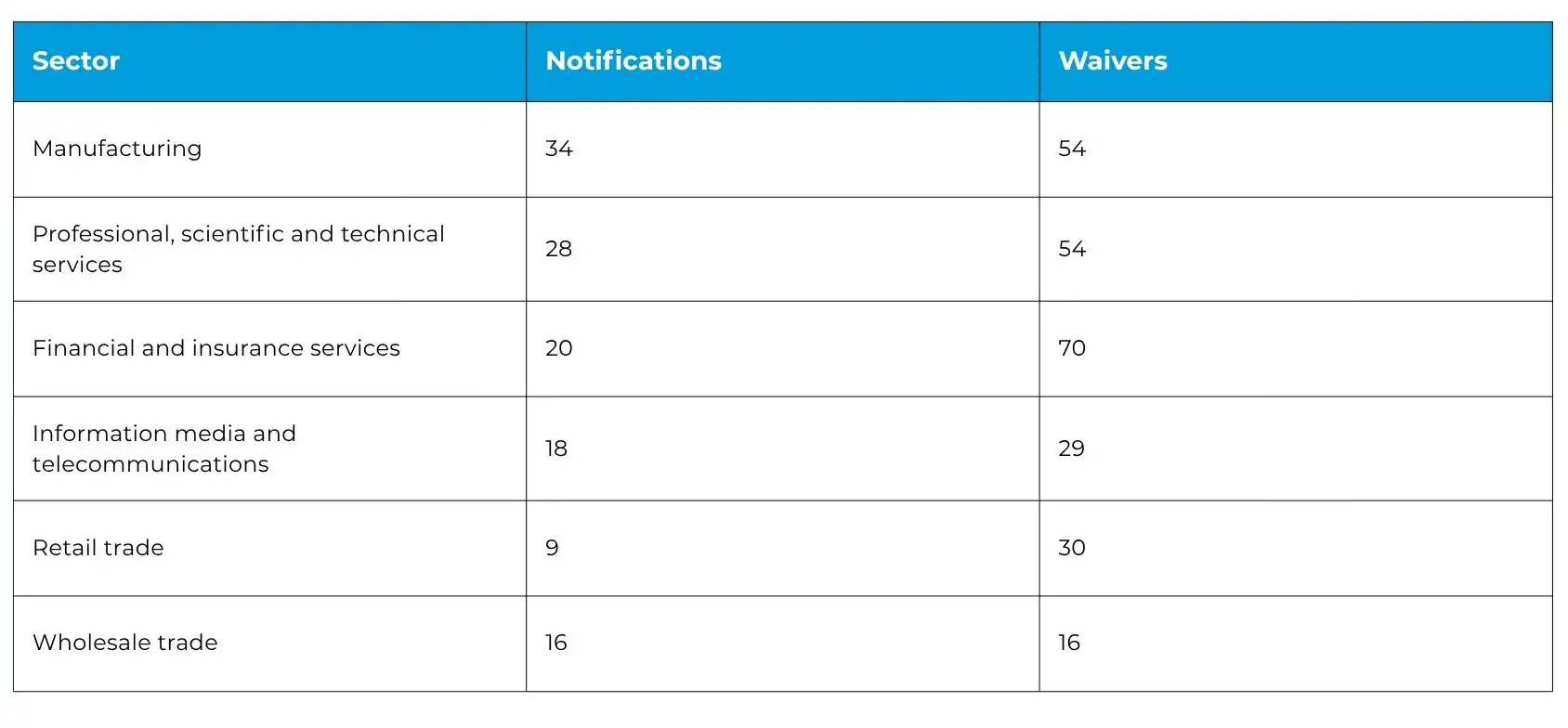
Source: ACCC, Merger control regime data for 1 July 2025 to 30 June 2026, published on 24 July 2026 and updated on 5 August 2026.
Based on the data released on 24 July, key figures include:
Taken together, the data shows that the regime is not simply a filing exercise. It is a transaction-planning issue that can affect cost, timing, conditions precedent, risk allocation and deal certainty.
For most transactions, the early experience is one of timely clearance. The median assessment period was 11 business days for notification waiver determinations and 17 business days for Phase 1 decisions. However, the regime is changing how transactions need to be planned, with competition analysis increasingly becoming a front-end transaction issue, requiring businesses to assess regulatory risks much earlier in the deal process.
The ACCC’s recent opposition to Coles’ proposed acquisition of a leasehold interest for a supermarket development in Kalgoorlie, Western Australia, reinforces this shift. While the decision was heavily influenced by the particular characteristics of the Kalgoorlie market and the ACCC’s concerns regarding the viability of an existing independent competitor, it demonstrates the regulator’s willingness to closely scrutinise acquisitions involving strategic assets, leasehold interests and development opportunities. Notably, this was the first ACCC opposition to an acquisition under the new regime. Coles has appealed the decision in the Australian Competition Tribunal.
The ACCC’s approach in the Ampol/EG Australia transaction provides a useful contrast. While the ACCC identified competition concerns in a number of local fuel markets, it approved the acquisition subject to Ampol divesting 41 retail fuel sites to an ACCC-approved purchaser. The decision demonstrates that transactions raising competition concerns are not necessarily prevented from proceeding, provided an effective remedy can be implemented to address the ACCC’s concerns.
These decisions are a timely reminder that businesses should not view merger compliance solely through notification obligations. The new merger regime introduces a mandatory and suspensory approval process for certain transactions, but it does not replace section 50 of the Competition and Consumer Act 2010 (Cth). That is, the ACCC retains the ability to examine transactions that may substantially lessen competition, including transactions that fall below notification thresholds.
Consequently, competition law risk may arise even where notification thresholds are not met or the parties consider the transaction to be commercially benign. The key question is therefore no longer simply whether a transaction triggers notification requirements, but whether it has the potential to attract ACCC scrutiny because it creates, strengthens or entrenches market power, or otherwise substantially lessens competition.
This assessment can extend beyond traditional business acquisitions to transactions involving strategic assets, leasehold interests and development rights.
For buyers and investors, the message is clear – competition law analysis should form part of transaction planning from day one. Early assessment of competition and regulatory risks can help avoid delays, preserve deal certainty and determine whether ACCC engagement is required.
Businesses that leave these issues until late in a transaction risk significant delay, investigation or prohibition of the entire transaction, exposing the parties to substantial regulatory and commercial risk.
The early data suggests the new regime is not preventing deals from proceeding, but it is changing how they are assessed. As the ACCC builds a deeper record of transactions and market activity, businesses pursuing growth through acquisitions, particularly repeat or serial acquisitions, should expect greater scrutiny of cumulative effects on competition. Early competition law assessment will remain critical to preserving deal certainty and mitigating execution risks.
For more insights on regulatory trends and developments affecting M&A transactions in Australia, read our latest M&A Review.
If you need assistance assessing competition law risks in a proposed transaction, please get in touch with us.
Disclaimer
The information in this article is of a general nature and is not intended to address the circumstances of any particular individual or entity. Although we endeavour to provide accurate and timely information, we do not guarantee that the information in this article is accurate at the date it is received or that it will continue to be accurate in the future.
Published by: